
How your drinking water gets treated, from stream to faucet
Here’s a look at the intricate system of infrastructure, testing, treatment, and the people who help ensure your water is safe to drink.
The water began to bubble, then gurgle. Brown, discolored water and bubbles slowly swirled around the trough.
“It’s going to get pretty loud in here,” said Eric Damon, plant manager of Aqua’s Crum Creek and Ridley Creek Treatment Plants.
Most people don’t think about their drinking water until something goes wrong. But behind every glass of tap water is a complex process designed to remove contaminants and make it safe to drink. Aqua’s Crum Creek plant can treat up to 25 million gallons of water a day for roughly 200,000 people in Delaware County.
One important step is filtration, using layers usually made of gravel, sand and anthracite to remove particles and contaminants from the water. Over time, those materials accumulate, requiring the filters to be cleaned.
That step is called backwashing, and it starts by reversing the usual flow of water, pushing it back through the filter. “We want to be as efficient with our process as possible and get a nice, long run time out of our filters before backwashing,” Damon said, raising his voice to shout as the bubbles increased, with water gushing through an open drain valve in the floor.
“When we backwash, we open up this drain valve. All the water will go down the drain,” he explained. “We then bubble air through the filter. That’s called an air scour.” The air scour helps expand the granular and porous materials used to filter the water. When it is lifted by the air bubbles, the particles collide together, which shakes off any stuck debris and sediment, which is then washed away.
As the water drained out, the sediment and impurities gave it the same shade as iced tea. The troughs then slowly refilled, this time with fresh, clear water.
“The backwashed water goes into a recycle station, which sends all that water back to the beginning of the treatment process. To conserve our source water, we recycle all of our process water at the Crum Creek Treatment Plant,” Damon said. The sediment, carbon, and other particles pulled out by the backwash process are dewatered into a dense cake that is sent to a landfill.
Backwashing is just one part of an intricate system at the plant. There’s also extensive daily testing (even on holidays) to comply with both state and federal health regulations.
So, let’s start at the very beginning. What happens before water reaches your faucet? Green Philly visited the Crum Creek Treatment Plant to follow the treatment journey from source to tap.
Going with the flow: Here’s what happens at water treatment plants.
For those of us who are not on a private well system, most of the water for residents of Philadelphia and the surrounding suburbs comes from creeks and rivers. That includes the Crum and Ridley Creeks, and the Schuylkill and Delaware Rivers.
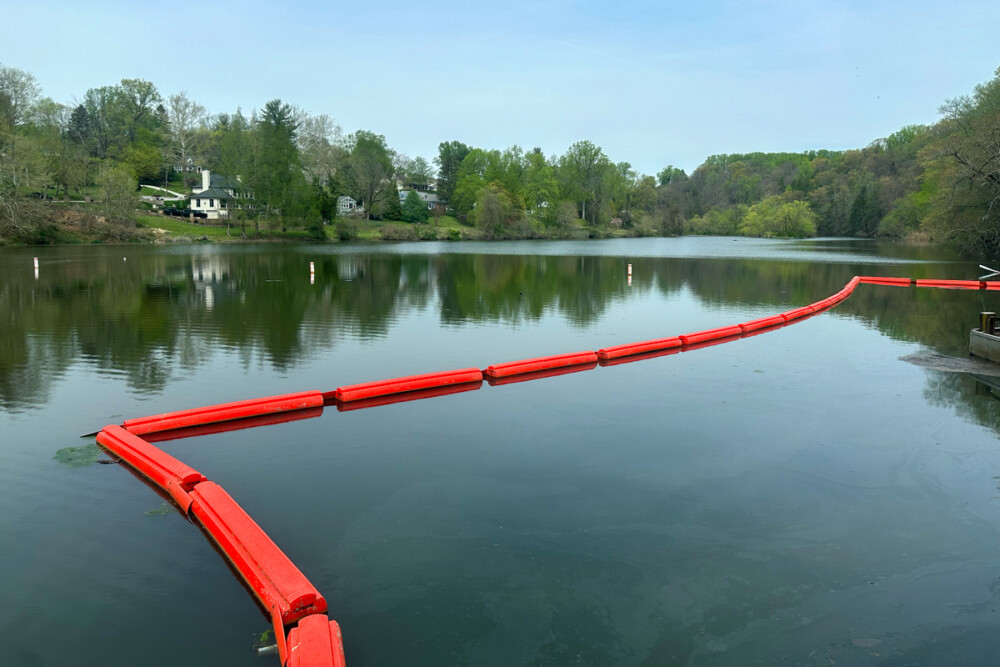
The water from somewhere like Crum Creek flows into a man-made reservoir, where it is held to ensure ample supply, or flows right into a treatment plant. Aqua, which operates the Lower Crum Reservoir and the Crum Creek Treatment Plant, manages conservation efforts to make sure that there is always enough water in the reservoir in case of emergencies, drought, or other severe situations, explained Damon.
Once in the treatment plant, carbon is added, which helps with taste and odors. It’s also a way to remove PFAS (or forever chemicals) and other impurities in the water.
“[Carbon] is the best way that we found to be able to lower the amount of mass in the potable water,” said Dr. Chris Crockett, Vice President, Chief Environmental, Safety, & Sustainability Officer at Essential Utilities. He compared activated carbon to an English muffin: its surface is filled with tiny nooks and crannies that trap and remove contaminants as water passes through.
Injected with carbon (and occasionally lime to adjust the pH), the water is pumped onto the top of sediment basins. Coagulants, or positively charged chemicals, attract negatively charged particles and organic matter. Those particles combined are called a floc, which are now heavy enough to settle to the bottom of the basins.
“The cleaner top water flows the length of the basins and is then piped down here to the filter building,” Damon said. “There’s big sleds in the bottom of the basin that move that sludge material out of there.” A separate facility then handles the waste material that is removed from the water, Damon added.
Once in the filters, more chemicals are added, including chlorine. Damon explains the chlorine must be added after the water has been cleared of sediment because if it is added too early, when there’s still too much organic matter, it could create unwanted compounds. These disinfection byproducts are carefully monitored to comply with EPA regulations under the Safe Drinking Water Act.
The water then trickles through the filters by gravity. Aqua uses a bed of sand with anthracite on top. “They’re great filter medias,” Damon said. “They let the water seep through relatively easily, the anthracite collects a lot of debris because it’s very angular and it has a lot of pore space, so it collects debris and contaminants.”
After it goes through the filter, the water is collected in a large clearwell where the chlorine has time to disinfect the water properly. Finally, it’s ready to be sent to the public through a network of distribution pipes, water storage tanks, and pumps.
When the treatment plant is running on a relatively low flow rate, a single drop of water could take about two hours to get through the system, according to Damon. If the plant must rush water through, it can be shortened to about an hour and a half.
Head to the lab
Treating water is only part of the job. Utilities also need to meet state and federal standards. Pennsylvania regulations include testing and monitoring requirements, disinfection rules, and strict limits on toxins, pathogens, and other contaminants.
These regulations are one reason Aqua has a state-of-the-art laboratory, which cost about $8 million to build. The lab tests water samples from different stages of the treatment process, from various sampling points out in the distribution system, and even from the raw water sources to keep everything on track and respond to live scenarios.
The lab also has a specialized taste and odor room.
“From a customer perspective, what you taste, smell and see is what you think, right?” said Crockett, while standing in the lab hallway. “All the fancy schmancy science doesn’t mean anything to the average person. If it doesn’t look safe, taste safe or smell safe, it doesn’t matter what the data says. The first thing it has to do is pass the eye test, the sniff test, the taste test.”
Next door is the research lab, where river water is tested for PFAS, chemicals, organic carbon, and more. Aqua is the only utility-owned and operated lab in Pennsylvania certified to test for PFAS. In 2024, they successfully tested 4,000 samples for PFAS alone, with help from a high-tech robot.
Crockett explains that about 10 years ago, the company decided to test broadly across the state, tracking down the sources of contaminants or PFAS that have ended up in the water. In the past several years, Aqua has filed lawsuits against the chemical companies and others who are responsible for PFAS chemicals being in the watershed and groundwater wells. Aqua says it intends to use any money won from these lawsuits to help pay for the cleanup in affected water systems so that customers don’t have to pay for polluters’ wrongdoing.
In addition to checking for salt levels, ammonia, lead, copper, and bacteria, other tests are run to make sure the treatments don’t have unintended consequences.
“It’s kind of like when you go to the doctor, and you get your checkup to check your blood, trying to make sure nothing’s out of sync. And if something is off, you have to go get more tests or an operation,” said Crockett. “For us, it’s adjusting the water plant or replacing a water main.” (A water main is the pipe that takes drinking water from a treatment facility to your street.)
The cost of clean water
This water treatment journey is expensive since it requires a lot of equipment, infrastructure, and experts. Depending on the water utility, these costs are covered by a mix of ratepayer revenues, grants, loans, bonds, or shareholder investments.
Aqua Pennsylvania operates and maintains 5,995 miles of water main in 33 counties (the newest added through an acquisition in Mercer County this year) and has 13 water treatment facilities.
In 2024, the company began a $14.3 million improvement project at the Crum Creek Treatment Plant, including a new concrete sediment basin and upgrades to the existing basins. In June 2025, the brand-new pretreatment sedimentation basin was placed into service. Work continues with additional upgrades and is expected to be completed this year.
Projects like these to update infrastructure improve reliability and help aid compliance with stricter water quality regulations, including standards like EPA updates to The Safe Drinking Water Act (SDWA) and maximum contaminant levels. For private water utilities like Aqua, customer rate changes must be reviewed and approved by the Pennsylvania Public Utility Commission. These investments are often cited as a factor in rate increase requests filed in state applications.
Protect the source
Before it gets to your faucet, your water has gone through multiple rounds of treatment, testing and tasting to protect public health.
But treatment plants can only do so much. Protecting rivers, streams and reservoirs from contamination – even from our own homes – is just as important.
In our next story, learn how residents and communities can protect drinking water at the source.
This is the second story in a three-part series about our drinking water, presented by Aqua, an Essential Utilities company. Join us to learn where your water comes from, how it’s protected, what it goes through before it reaches your tap, and what actions you can take at home.
Become a Supporter!


