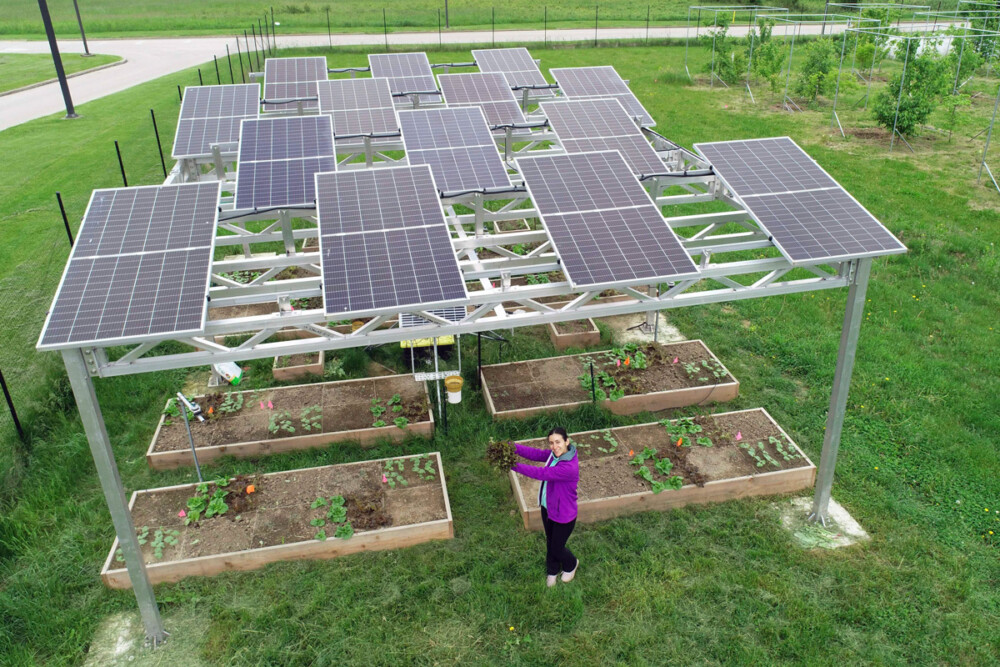
Growing food or energy? Agrivoltaics says Pennsylvania farms can do both
Agrivoltaics, combining agriculture and solar energy, could be a tool in climate change, support farmers and clean energy
As energy demands explode due to the construction of data centers, farmers and communities are facing a difficult question: Should land produce food or energy?
Agrivoltaics proposes a third option: both.
Solar power was the fastest-growing form of energy last year. But space is at a premium and, contrary to popular belief, the best location for solar arrays is not rooftops but instead the large, flat expanses of land typically used for farming.
There’s a tradeoff, especially in historically agricultural states like Pennsylvania, of land for food versus land for energy production. But there’s a possible solution: Co-locating agriculture and solar energy production on the same land in a process called agrivoltaics.
For many farmers, the idea of their land being converted to solar is worrying. Pennsylvania lost over 4,000 farms, or 7.7% – between 2017 to 2022, according to the United States Department of Agriculture’s 2022 Census of Agriculture. Dr. Sujith Ravi, an associate professor in Temple University’s Department of Earth and Environmental Science who researches the consequences of food and energy production on land use, posits that embracing agrivoltaics could offer a buffer against some of the issues facing modern farmers.
“Farming as a whole is not a profitable business in many cases,” Ravi said. “If they have an opportunity to do both [farming and solar], it’s going to be a win-win scenario, because you have additional revenue from the solar at the same time you can still do farming.”
Agrivoltaics – one solution in climate change?
While most agrivoltaics research has been on large-scale farming operations, Temple University alumna Caroline Merheb focused her research on urban agrivoltaics while she was a doctoral student. Dr. Merheb, who is getting her PhD in geoscience and whose father is a farmer in Lebanon, has been drawn to agriculture since she was a kid.
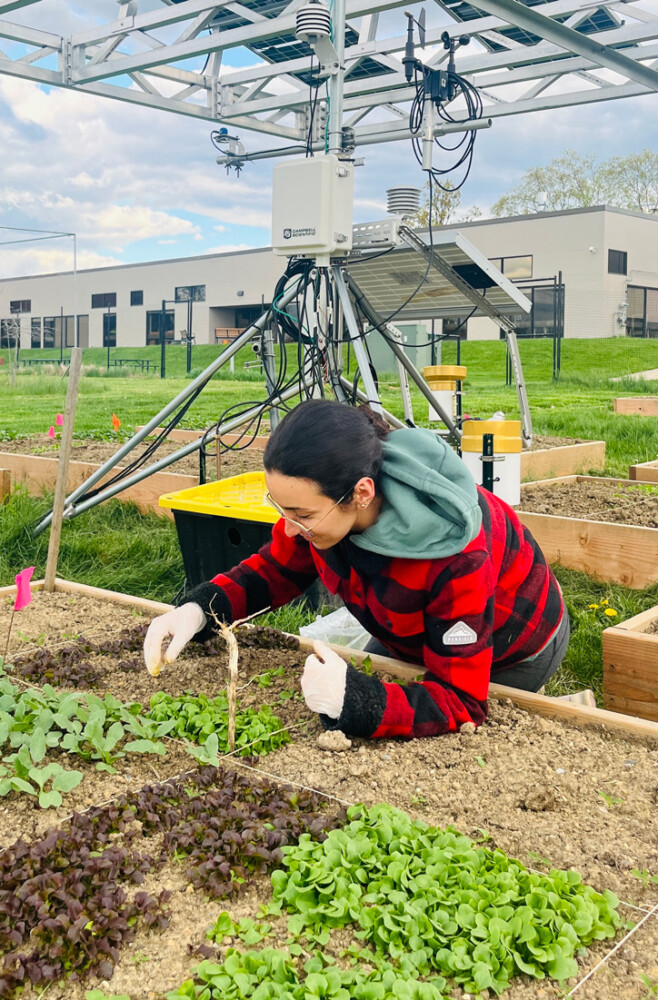
Working under Dr. Ravi, her team built an agrivoltaic site at Temple Ambler and monitored the microclimate, weather, and soil for three years. During one extreme heat event, a spinach crop under the solar panels survived while the control crop died growing under full sun.
While some crops, like cherry tomatoes and beans, saw lower yields under the solar panels compared to the control group, leafy vegetables had 2-to-3 times higher yields under the panels.
“It told us that agrivoltaics can be a mitigation to help later on with extreme heat events, especially as these events can be happening more frequently in the future with climate change,” said Merheb.
Merheb posits that agrivoltaics could one day function in urban areas similar to community gardens, helping increase healthy food access and creating energy to offset rising electricity bills. Other benefits include possible use as community spaces, stormwater management, and fighting the heat island effect in cities like Philadelphia.
Even better? Her research showed that only 9% of vacant spaces in low-income neighborhoods would have to be converted to agrivoltaic systems to supply those neighborhoods with food and energy.
Types of Agrivoltaics
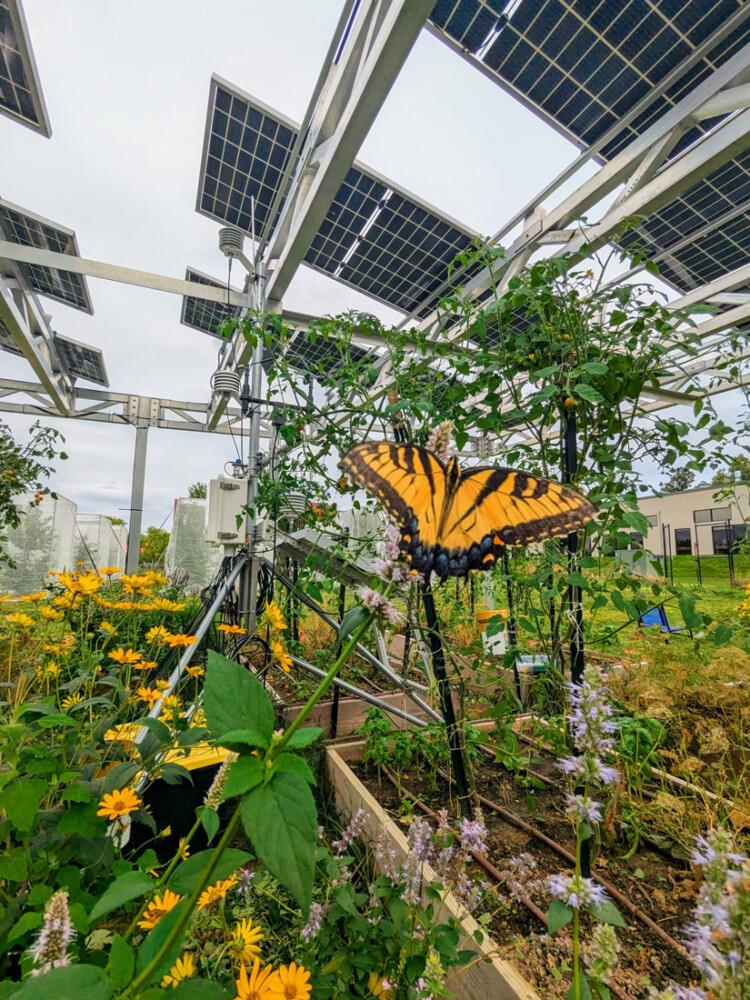
Farmers who integrate solar panels into their infrastructure have a choice of agrivoltaics. The most common form of agrivoltaics in the United States falls under the “ecovoltaics” umbrella – the planting of native grasses, plants, and wildflowers under solar panels, which can increase pollinators.
Another type, “range grazing,” introduces livestock that graze on the land beneath solar panels, helping produce byproducts such as dairy, meat, and wool. It is a symbiotic relationship, since solar panels can provide shade for the livestock while the animals eat vegetation and leave droppings that improve soil health.
The least common type of agrivoltaics, often referred to by the umbrella term, pertains to growing food crops under solar panels. It is rare, in part, because it is much easier for farmers to lease their land to solar developers and abandon the hope of agriculture.
But agrivoltaics also has its upsides: Transpiration, the process in which plants release water during photosynthesis, can help keep the solar panels above them cool and lower the amount of water needed for irrigation. And, of course, this would allow the land to remain in agricultural use while solar energy is being captured, potentially allowing two streams of income from one parcel of land.
The future of agrivoltaics
While the research is promising, the field of urban agrivoltaics remains largely hypothetical. Due to zoning and regulatory issues, the researchers at Temple Ambler weren’t able to connect their solar panels to the grid, a microcosm of the roadblocks faced by many urban agrivoltaic projects. Undertakings such as Merheb’s agrivoltaic community garden would need more research, supportive zoning and legislation, and funding to come to fruition.
However, agrivoltaics isn’t a silver bullet. “I always feel like [agrivoltaics] should not be overestimated as a solution for everything,” said Merheb.
Early adopters have started seeing success. As of late 2025, the just under 600 agrivoltaics projects in the United States had created 10 gigawatts of electricity, enough to power 7.5 million homes.
While agrivoltaics won’t solve every climate or energy challenge, researchers believe it could help cities and farms become more resilient – producing food and power from the same piece of land in a hotter future.
Photo by Josh Caplan
Become a Supporter!