
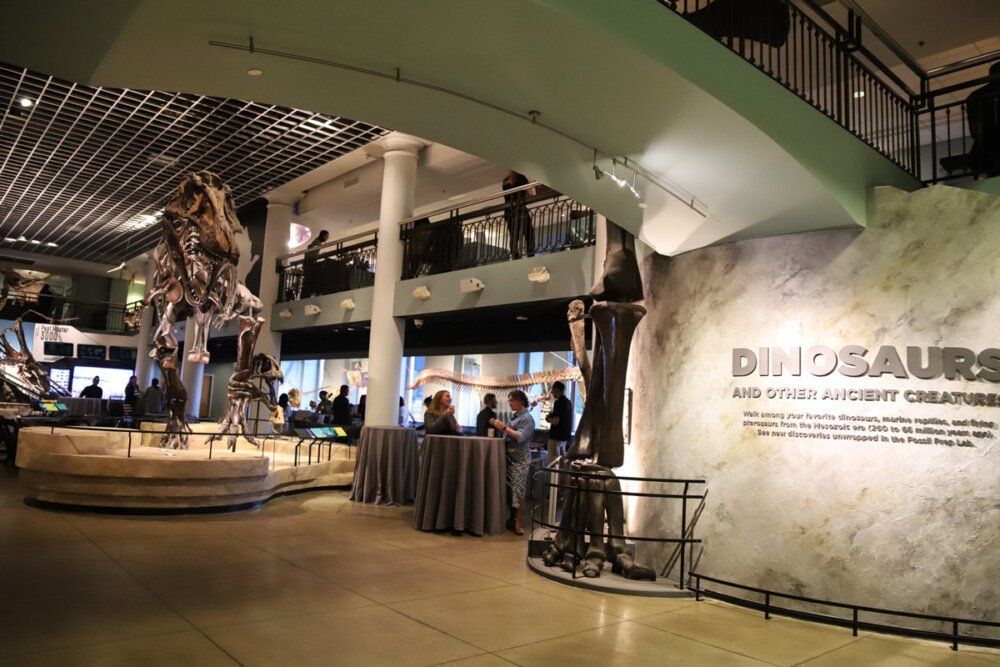
Dinosaurs may be extinct. But the Academy of Natural Sciences doesn’t have to be.
The Academy of Natural Sciences survived for more than two centuries. Now, its future depends on public pressure and accountability.
I was a doctoral student at Drexel from September 2017 until just last month, September 2026, when I successfully defended my dissertation. A part of my education, I spent a significant part of my time as a student both behind the scenes at the Academy of Natural Sciences (ANS), and doing some public outreach on occasion. Like many who have worked at ANS in any capacity, I grew up regularly going to the Academy of Natural Sciences, and it was a full-circle moment when I started behind the scenes as a graduate student.
I saw the gradual decline of ANS throughout my time. It happened in various ways, from reduced museum hours, fewer to no fundraisers, major staffing cuts twice (not counting recent staffing cuts, which would make it a third time), restructuring of jobs, the closure of the Butterfly room, and retiring education animals from Outside In.
Whether or not Drexel’s financial mismanagement has been intentional as some of the online discourse suggests, it is still a gross mishandling of a beloved institution that could be very popular and profitable but was allowed to wither away since their partnership with Drexel.
ANS was founded in 1812 and opened to the public in 1828. Two weeks after Anthony J. Drexel’s 200th birthday, and two years short of its 200-year public anniversary, the Academy of Natural Sciences closed on September 27, 2026. This museum had been open for over 60 years by the time Drexel University founder Anthony J. Drexel started a venture that would eventually become Drexel University. He was a financier and philanthropist but didn’t have a formal education of his own, which likely added to his motivation for starting the Drexel Institute for Art, Science & Industry. Mr. Drexel would probably be shocked to learn that this museum – which was such a prominent academic and scientific institution in his time as well – was allowed to flounder under the supposed support of a university that he founded.
Communications and statements from the university indicate that despite the public-facing side of the museum closing, that the Academy collections will continue to operate and support research. However, if they plan to move the collections, as they indicate is a possibility, then research would have to cease in order to prepare the specimens for such a move.
ANS is home to millions of specimens including insects, mollusks, birds, plants and fungi, invertebrate and vertebrate fossils, mammals, rocks, and minerals. The building itself is built and graded in such a way that it can handle the weight of millions of specimens. So, moving them would be no easy feat – likely costing more than the land itself. Not to mention that all of these scientifically valuable specimens need temperature control, specialized cabinets and trays, and expert management. This alone makes the lack of transparency and communication surrounding what will happen to the museum and its collections concerning.
The good news is the fight is not over – Save the Academy formed to fight for the reopening of the museum. You can join me and others by taking action following the group’s guidance on their website. There is a City Council Committee on Legislative Oversight hearing on Monday, October 26 at 2 p.m.
This hearing is incredibly important as it can require Drexel to be more transparent about why the museum closed. This hearing will cover the decision to close the museum, with the power to subpoena testimony. This hearing is where people who made these decisions about the museum will answer questions on the public record. Save the Academy is encouraging everyone who can to attend so that we can continue to show Drexel, the Academy of Natural Sciences, and the City of Philadelphia how important this educational and scientific resource is to us as a community.
Submitted by Heather Kostick, PhD, Associate Director, Penn Center for Science, Sustainability, and the Media
Cover photo: Academy of Natural Sciences
Become a Supporter!


