
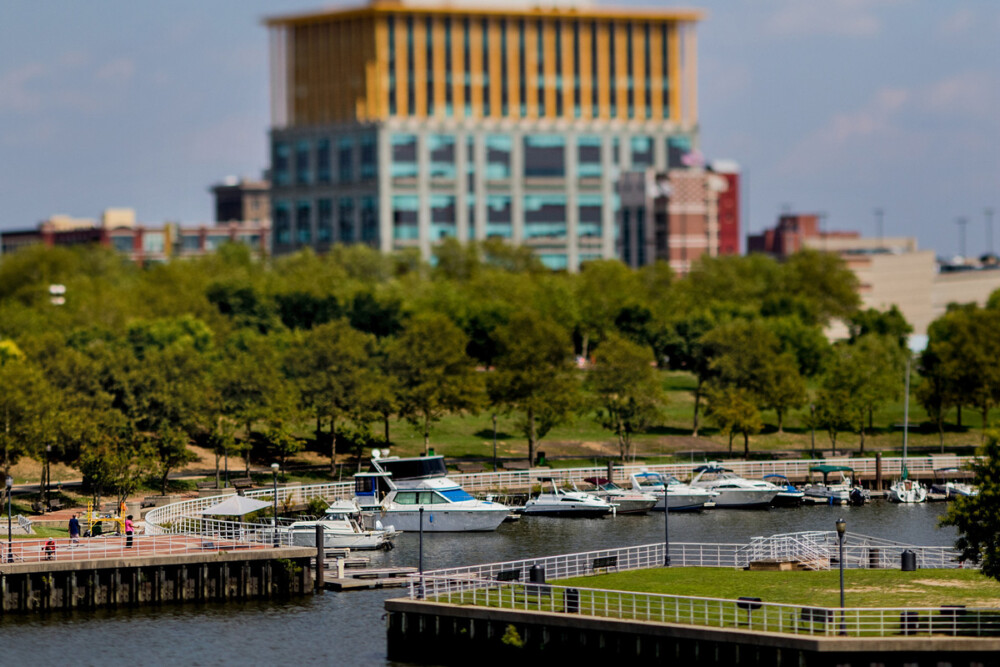
Want to show voters what’s possible? Take them on a boat.
Ahead of Election Day, Camden County water advocates took residents onto the Delaware River to show what’s possible for local waterways. Now, a voter-approved tax increase could help make that vision a reality.
By Election Day, many voters become frustrated with the endless political text messages. In Camden County, advocates took an approach to show constituents firsthand what’s possible by getting them offline – and on the water.
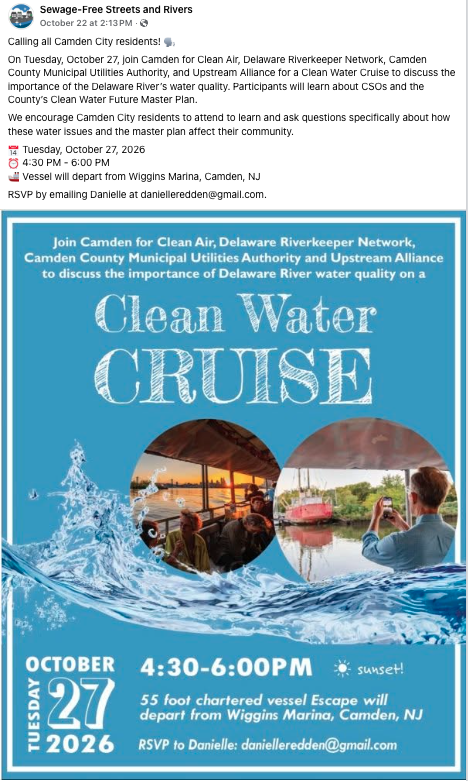
Representatives from Upstream Alliance and the Camden County Municipal Utilities Authority (CCMUA) took residents onto the Delaware River leading up to Election Day to highlight progress in cleaning local waterways and help them envision a future where cleaner water is not just an environmental goal, but a resource Camden County residents can fully enjoy.
On Nov. 3, Camden County voters approved an increase to the county’s open space tax to help fund a $400 million initiative to improve water quality, reduce flooding, and restore local waterways. The investment could also expand recreational access and bring swimmable water back to the Cooper River.
The measure raises the county’s open space tax from 2 cents to 3 cents per $100 of assessed property value to create a dedicated funding source for long-term environmental restoration. The broader $400 million plan includes a variety of projects and efforts, like a $200 million to reduce combined sewer overflow, $50 million to repair sewer systems, $75 million for dredging, $50 million to clean recreational lakes, and $25 million for green stormwater infrastructure like rain gardens.
The hour-long rides highlighted kayak launch points and the former Harrison Avenue landfill, now a park frequented by deer. According to CCMUA’s Ell Bivona, “The park is beautiful and reflects the benefits of prioritizing smart investments in infrastructure and environmental justice and ecological restoration all at the same time.”
A major factor in water cleanup is investing more in separating sanitary and stormwater flows. Tim Feeney, engineer at CCMUA, describes two phases of sewer separation expected to prevent approximately 15 million gallons of combined sewage in the first phase and another 20 million gallons when the upstream neighborhood is addressed.
Bivona says pollution affects the entire Cooper River and the Big and Little Timber creeks, even though the impacts are especially visible in Camden and Gloucester City, which sit downstream.
Leaking sewer pipes create another challenge. As groundwater and rainwater seep into deteriorating pipes, the wastewater system must treat that additional flow. Bivona estimates that infiltration and inflow contribute approximately 40 million gallons annually to the wastewater treatment plant.
Freeing up that capacity could allow the system to treat more wastewater from Camden and Gloucester City, improving water quality while easing the burden on communities already facing economic challenges.
Wastewater treatment may also capture some microplastics and other pollutants. Feeney explains, “Solids removed during treatment can contain heavy metals and microplastics, although the facility is not specifically designed to remove microplastics. Stormwater runoff carries pollutants from roads, including tire particles, oil and brake-pad residue, into local waterways.”
In communities with separate stormwater systems, that runoff can flow directly into streams unless additional treatment measures are in place. Combined sewer systems typically send stormwater to treatment plants, but heavy rainfall can overwhelm their capacity, resulting in sewage overflows. The investments aim to improve that infrastructure while incorporating green solutions, including rain gardens that can help manage stormwater and improve neighborhood streets.
For water advocates, these goals extend beyond cleaner rivers. It is about giving residents safer, healthier waterways and more opportunities to connect with them. The boat tours offered a glimpse of what that future could look like. Now that voters have approved additional funding, the next step is to turn the vision into improvements for residents to enjoy their rivers and streams.
Photo: Camden County

Become a Supporter!


