After 20+ years on Superfund list, Franklin Slag Pile cleanup moves forward – without a clear climate plan
EPA begins long-awaited remediation of the contaminated Port Richmond site, which is increasingly vulnerable to flooding as the climate warms.
The Franklin Slag Pile is one of Philadelphia’s most hazardous sites – contaminated by decades of copper smelting/industrial waste and projected to flood once a year or more by 2050.
Doris Lynch, who lives near the Franklin Slag Pile, is concerned that contaminants from the site could spread throughout the area as human-caused climate change intensifies the frequency and severity of flooding.
“Every base needs to be covered,” said Lynch. “If there’s a possibility of something happening, the EPA needs to just make sure it doesn’t.”
A toxic legacy in Port Richmond
Lynch moved to Port Richmond, a working-class neighborhood in northeast Philadelphia, when she was seven years old. It was the late 1960s and the Franklin Smelting and Refining Corp. had shuttered because of pollution violations.
Across the street, a new company had opened, MDC Industries. They sold copper slag, the byproduct from the smelter, as a sandblasting material and for asphalt shingles. On a windy day, it wasn’t uncommon for workers to find grit in their drinks or glasses.
Over the years, Lynch moved around the country, but felt a pull to return to Port Richmond when her son was born.
“It was all my memories, it was always home to me,” she said.
Lynch bought a house in Port Richmond in 1996, three years before MDC Industries closed. She said if she had known about the site, she never would have returned to the neighborhood.
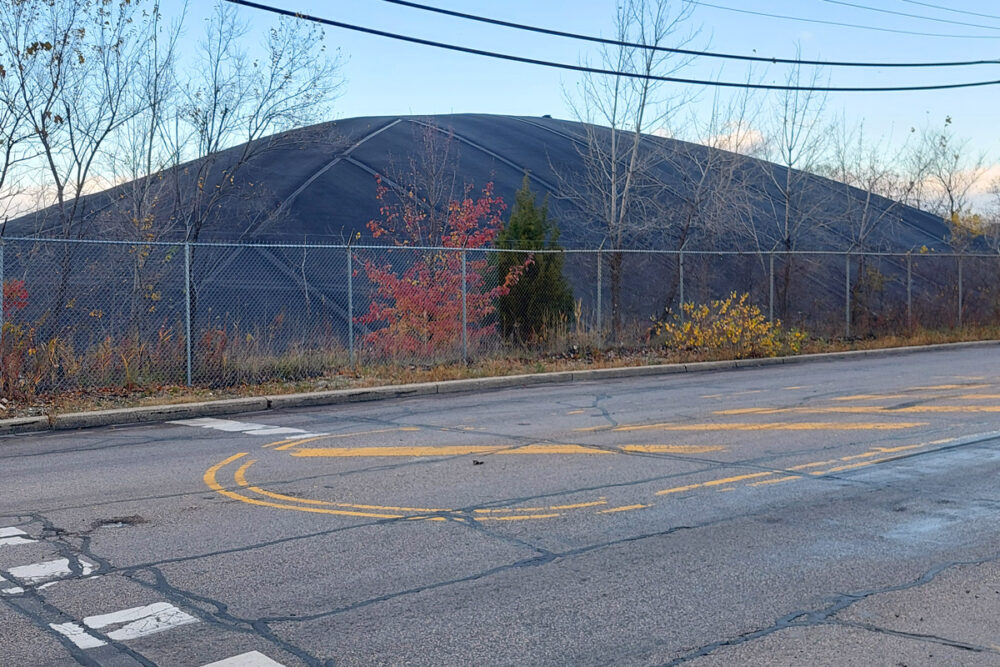
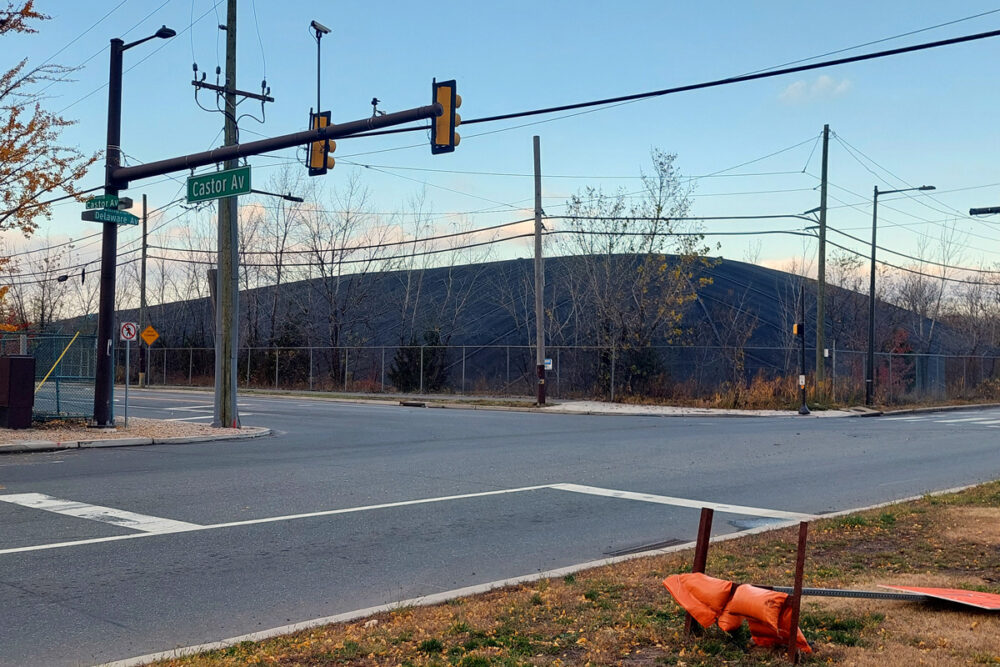
The legacy of MDC Industries is a large, abandoned pile of slag and soil that emerges from the ground like a sleeping giant at the intersection of Castor and Delaware avenues. An eight-foot chain-link fence surrounds the site with signs warning passersby of the dangers inside.
Slag looks a lot like a pile of black dirt, but up close, the texture is similar to coarse sand. This particular pile contains a chemical cocktail, including high levels of lead, copper, and chromium. Over time, these chemicals migrated off the property into the surrounding areas. Lead would be found in the air, the storm drains, even the nearby Delaware River.
In 2000, the EPA removed the slag that had gone off-site, consolidated the contamination into one large pile, and placed a special tarp over the pile as a temporary solution to prevent the slag from moving. The agency also removed nearly 12,000 tons of slag and disposed of the material at an off-site facility.
Two years later, the agency deemed the pile a Superfund site and placed it on its National Priorities List of most hazardous places in the country.
Since then, the site hasn’t changed much. That’s because Superfund cleanups are often expensive and take a long time.
Climate change complicates superfund cleanups.
EPA officials said the contamination from this site – the Franklin Slag Pile – no longer poses a risk to nearby residents, but those who lived in the neighborhood prior to 2000 may have been exposed to contaminants in the soil, stormwater runoff, and air, according to a public health assessment by the Agency for Toxic Substances and Disease Registry.
The agency recognizes this site is vulnerable to flooding, and contaminants could escape and spread into the environment.
That’s one of the reasons why, nearly 70 years after MDC Industries began polluting the site, a cleanup through the federal Superfund program is expected to begin this summer.
Efforts to contain the pile’s contamination are getting more difficult because of human-driven climate change. The U.S. Government Accountability Office detailed these risks in a 2019 report: storm surge, sea level rise, and flooding, with a small portion of the site located along Delaware Avenue falling within the 100-year floodplain.
Despite this, climate change and the climate risks are not mentioned in the site’s cleanup plan. However, the EPA released its 2024-2027 Climate Adaptation Plan, which builds on prior plans and, in part, addresses climate impacts on Superfund sites across the country.
The EPA is aware of climate change issues in a broad sense, but agency officials are bound by procedures they’re supposed to follow when they decide how a Superfund site gets cleaned up, said Hilary Sigman, an economics professor with Rutgers University. She recently authored a study that showed limited evidence that the EPA is incorporating climate-related risks into Superfund clean-up plans.
“My sense is that a lot of those procedures are not very future-oriented,” she added.
That may partly reflect why climate risks aren’t mentioned in the Franklin Slag Pile Superfund site clean-up plan. Sigman said in 2021 she found very few references to climate change in any of the clean-up plans for the country’s Superfund sites.
“I found only one where it was brought up by the EPA, as opposed to by a commenter, as a consideration in the decision-making,” she said. “If you look at their more recent reports, I think you’re starting to see more references to climate change, but I was surprised at how little direct, even mentioning of the climate change considerations are present in those reports.”
It’s not just hazardous sites that are at risk of more frequent and severe flooding in Philadelphia.
In 24 years, when today’s babies will be settling into the workforce and within the terms of a mortgage, 1500 acres in Philadelphia County are expected to flood every year, according to a recent Climate Central report.
Long-awaited cleanup plans
Right now, the EPA plans to treat and stabilize the contaminated soil and slag on-site by mixing it with a material that will render it non-hazardous. The agency will then test, transport, and dispose of the treated material at a permitted off-site facility.
Cleanup, estimated to cost $21,638,100 (with the State of Pennsylvania responsible for 10%), is scheduled to be completed by November 2029.
Lynch, now 61, said she initially became aware of the Franklin Slag Pile Superfund site about five years ago through her work with the Port Richmond Neighborhood Action community group but had not heard anything about the site recently.
“When you have time to sit back and engage in your neighborhood and learn about different things some of them can be very shocking,” she said. “People just moving here, they don’t have a clue.”
The EPA last held a community meeting to discuss the site’s clean-up progress in 2024. The next meeting will take place from 6-8 p.m. on March 2 at the Columbia Social Club (3521-29 Almond Street).
Lynch said she hopes the end result will be the development of a community center or affordable housing that’s “safely developed” on the site.
This reporting was made possible through funding from the Keystone News Summit, powered by The Lenfest Institute for Journalism and the Patricia Doherty Yoder Institute for Ethics and Integrity in Journalism and Media at Duquesne University.
Become a Supporter!